1. Renewal decisions recorded before the internal deadline
Divide documented decisions made before the internal decision date by all decisions due in the reporting period. A decision to renew, renegotiate or end the agreement counts if it comes from the person with authority under the team’s policy. An alert delivery or a meeting invitation alone does not establish a decision.
Use the date the decision was due to select the group, even if the owner finally decided next month. In this worksheet, a calendar date means “decision in hand before this date.” A decision on September 15 misses a September 15 cutoff. If your policy allows decisions through close of business on that date, document the rule and use an inclusive comparison. Capture timestamps and time zones where the actual cutoff requires them.
Keep the approver’s decision and date, the internal cutoff, the contractual notice deadline and proof of any notice that must be delivered. The renewal reminder process explains the handoff between deciding and serving notice.
2. Obligations completed and verified on time
Count all obligations due in the period. How many were both completed and verified by their due date? Divide that second count by the first. This measures the complete handoff, including evidence acceptance. Assign one owner to deliver and a verifier to accept the evidence.
Fictional example. A project lead delivered training on September 23. The signed attendance record arrived September 24. The obligation was due September 25 and the verifier accepted the record September 28. Keep all three dates. The training may have met its contractual delivery requirement, while the internal verification KPI records a miss. Operations can fix an evidence-review queue without incorrectly telling the counterparty that it breached the agreement.
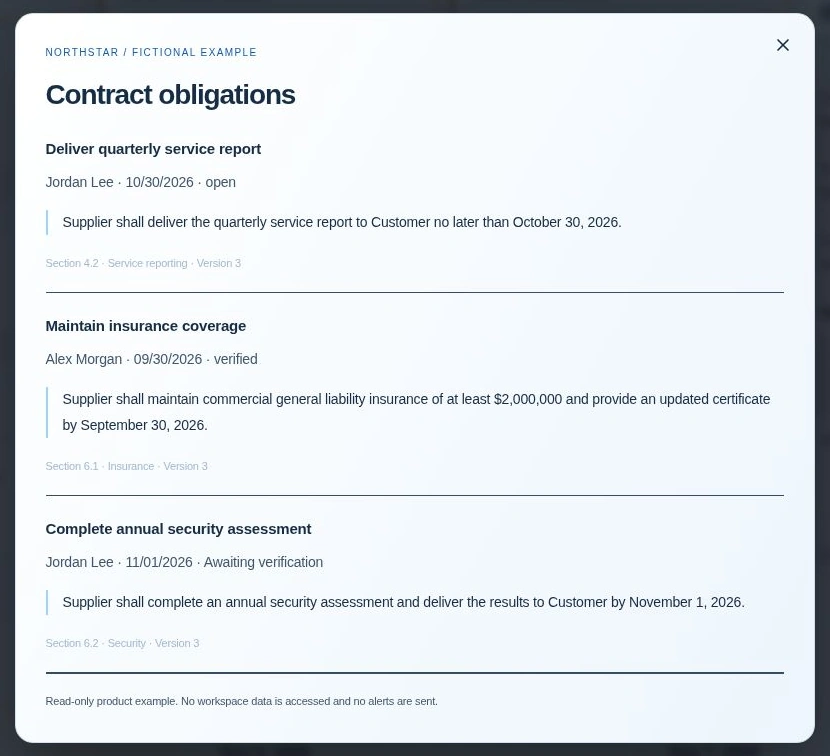
Ask the contract administrator to check due-date changes before close. Retain the old date, approved extension and source for the revised due date. An unresolved waiver belongs on the exception list. See how ContraxAware tracks obligations and their evidence.
3. Median days from complete request to final signature
For each agreement whose final signature falls in the period, subtract the complete-intake date from the final-signature date. Sort the resulting calendar-day durations. With an odd count, use the middle value. With an even count, average the two middle values. NIST’s definition of the median.
Use an agreed intake milestone. Here, intake is complete when the requestor has supplied the counterparty, business owner, agreement type and draft or template. An initial email asking “can we get a contract?” does not start this example’s clock. A signature packet with the second required signature still outstanding remains open.
Report agreement count and type with the median. Five routine service orders and five heavily negotiated master agreements can tell different stories. Keep a separate aging view for open requests and identify the oldest item and its current reviewer.
Fictional example. Each bar uses its own denominator and represents the share completed on time.
- Renewal decisions made on time90% (18 of 20 agreements)
- Obligations verified on time80% (32 of 40 obligations)
Median time to sign · 15 days
Example values (days) · 8, 12, 15, 21, 30
Make the numbers useful in a regular review
For every KPI, name the data owner, reporting period, exclusions, and action threshold. Show counts as well as rates. Review a few underlying records to check that the summary matches what happened.
Start with the contract register, approval history, signing records, and obligation evidence your team already maintains. ContraxAware keeps these workflows connected; confirm the available views or export the underlying records to calculate a metric. This guide does not imply that every formula is a built-in dashboard.
Run a monthly review that ends with an owner and an action
Fictional September close. Eighteen of 20 renewal decisions met their internal cutoff (90%). Thirty-two of 40 obligations had both timely completion and timely evidence acceptance (80%). Five signed agreements took 8, 12, 15, 21 and 30 calendar days. The median was 15 days. An unsigned request open since August belongs in the aging review, outside that group of five.
- Procurement opens the two missed renewals. Check whether the decision maker received the request in time and whether someone else owned the separate notice action.
- Operations examines the eight obligation misses. Separate late delivery, late verification and missing evidence before assigning corrective work.
- Legal operations checks the oldest open request. Confirm who owes the next action. An improving median alone gives no answer about that agreement.
Download the contract KPI worksheet (Excel). The workbook contains fictional records behind all three September results. Change the reporting dates to inspect a different period. Where nothing was due, the denominator is zero and the rate displays as not applicable.
Use your contract reporting and underlying records for inputs. Keep the calculation rules and a copy of each month’s report so later changes to a due date do not quietly rewrite last month’s result.
Frequently asked questions
What should I report when no renewal decisions are due?
Show that zero agreements needed a decision and leave the rate blank or mark it as not applicable. A zero percent rate would describe a different result.
When does an obligation count as completed on time?
Define the evidence and acceptance rules first. Count obligations whose completion meets those rules by their recorded due date and report how many were due.
Why report the median time to sign?
A small number of unusually slow agreements can move the average. The median shows the middle elapsed time. Include the sample size and break out separate agreement types when their processes differ.