Start with the work that is costing your team time
A three-person evaluation group is enough. Procurement brings a supplier agreement and explains its renewal. An operations colleague who rarely uses the current filing system tries to find it. Finance checks the quote. Include legal or your contract reviewer if departures from standard language require approval.
Fictional test packet. An equipment-service agreement runs through June 30. A signed amendment changes the notice period from 30 to 60 calendar days. A later unsigned quote proposes 90 days. Use anonymized or sample files, give both vendors the same instructions and keep an answer key for the evaluator. The correct answer must identify the executed amendment and the clause it changes.
Download the small-business software scorecard (Excel). Edit the task weights, record what each tester saw and enter comparable prices. It reports missing tests and unsatisfied requirements separately from the numeric score.
| Give the vendor this task | What to look for |
|---|---|
| Open a signed supplier agreement | A colleague can find it and identify which amendment is current. |
| Send a draft to a reviewer | The reviewer can see the right version and the action they owe. |
| Set a reminder for a notice deadline | A responsible person can verify the date and see when they will be alerted. |
| Export the agreement record | Your team can retrieve the signed original and see which details export with it. |
Look for a searchable contract home
Check whether the system can bring in your existing agreements and make them easy to find by company, contract type, and text. Ask how related amendments and supporting files appear and whether you can retrieve your originals.
Try a search using wording from a contract your team actually uses. If a system proposes details with AI, check how your team reviews those suggestions against the original document.
Make dates and responsibilities visible
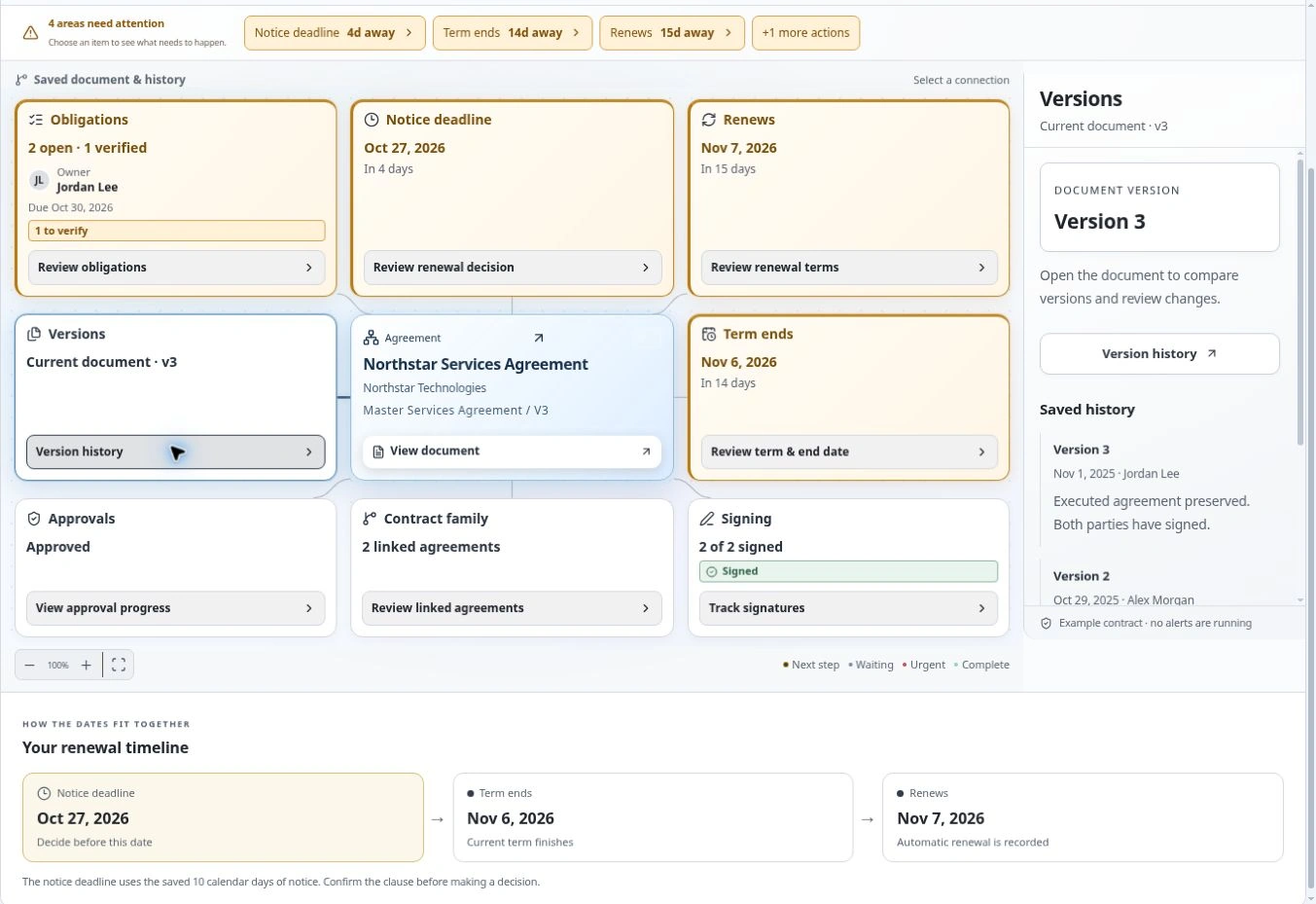
Ask how expiration dates, renewal dates, notice deadlines, and obligations are recorded. A reminder on the day an agreement renews may leave too little time to act. Look for clear ownership and a way to plan the review before the applicable notice deadline.
A good demo should show the complete path from an imported agreement to a date, its source wording, and the next action. Explore contract renewal tracking and obligation management for examples.
Run the same four tasks during each trial
| Task and weight | What the evaluator should see |
|---|---|
| Find governing wording · 35% | A first-time user searches by supplier, finds the signed amendment and distinguishes the unsigned quote. |
| Set a notice reminder · 25% | The user checks the source and notice rule, selects an owner and backup, and shows when the first reminder is scheduled. |
| Review a changed version · 20% | After a price change, the reviewer identifies which version needs a fresh decision and where that decision is recorded. |
| Retrieve an export · 20% | The tester downloads the signed files and record details, opens them outside the product, and can match them back to the agreement. |
Give each demonstrated task 2 points if the tester completes it without the vendor taking over, 1 if they need hands-on help, and 0 if the attempt fails. Leave an untested task blank. Multiply each percentage weight by its score divided by 2 and sum the results. A verbal “yes” stays in the follow-up column until the team sees the task work.
Compare access, adoption, and cost
Review who can see or edit contracts, how users are added, and how the product handles sensitive information. Ask about implementation, user training, support, contract capacity, and what happens if you need to export your data.
Compare the full cost for the people and agreements you expect to manage. Have the people who will use the system try a realistic task before deciding. See ContraxAware for small businesses or review plans and pricing.
Break a tie using permissions, exports and first-year cost
Two checks can rule a system out. Ask an authorized administrator to test a restricted agreement using an ordinary user’s role. Ask the evaluator to open an exported executed original and its amendment outside the system. A product can pass the export task with vendor help, yet still leave an access issue. Record the specific evidence and the owner of any retest.
Fictional comparison. Two products score 90 out of 100 because each evaluator needed help routing the changed draft. Tool A passed both requirements. Tool B allowed the test user to open the restricted agreement. Tool B costs $1,400 for year one and Tool A costs $1,680 under the sample quotes. The procurement lead asks Tool B to demonstrate a corrected role and reruns the same test. Finance compares prices only among systems the team can use.
Use a common scope for each quote. Add twelve months of base fees and chargeable seats, one-time migration or implementation fees, and required annual charges. Document the agreement volume, storage, submission and reviewer roles, what support is included, and renewal pricing. A free trial should answer a real operating question. See ContraxAware pricing or run the four-task test in a trial.
If the pilot succeeds, pick the owner of the first migration batch and follow the shared-drive migration checklist. For buying criteria across a larger team, see the business contract management software guide.
Frequently asked questions
When should a small business replace its contract spreadsheet?
Run a pilot when the spreadsheet can no longer reliably tell you which version governs, who owns a decision, or what deadline is coming. Start with the agreements that are creating the problem.
Should a small team start by importing every old agreement?
Begin with active agreements that have upcoming decisions or obligations. Verify the original files, owners, and dates before deciding what historical records also belong in the system.
How do we compare flat pricing with per-user pricing?
Cost both plans with the number of people who will submit, review, sign, and administer agreements. Ask which roles count as paid users and what migration, storage, support, and exports include.