 ContraxAware
Core chapter 11 of 18
Financial Tracking, Value Leakage and Spend Analytics
Connect commercial terms to observable financial outcomes without confusing contract records with accounting.
Executive summary
- Define the number before adding it. A monthly rate, a commitment, an invoice and a payment answer different questions. Label the basis, currency, service period and source.
- Build a bridge from agreement to invoice. Start with the contractual baseline, add authorized changes and compare the resulting expectation with comparable invoice lines.
- Give every variance a disposition. Show the open amount, supporting evidence, person investigating and next decision. A candidate credit can remain open across several reporting periods.
- Claim an outcome once. Finance should be able to reproduce the economic benefit using actual volumes, comparable scope, incremental costs and evidence of the final disposition.
Part A · The Why
Define what each financial value means
Commitment, annualized value, actual spend and forecast
A finance director asks, “How much are we spending with this supplier?” Before opening a report, ask what decision the number will support. Negotiating next year's price needs the likely volume and continuing scope. Reviewing payments made this month needs the accounting period, supplier identifier and actual payment data. A single field called contract value obscures those differences.
A commitment comes from an enforceable obligation under the applicable terms. An annualized rate converts a recurring price into a twelve-month equivalent. Actual spend needs a definition from Finance, such as net invoices posted for the service period. A forecast estimates future cost from assumptions that should be visible and dated.
Take a six-month, nonrenewing support agreement priced at USD 2,000 a month with no other charges. Its full scheduled service fees total USD 12,000. Its annualized run rate is USD 24,000. Forecasting another six months would require a new assumption about continuing service. If a portfolio report treats all three amounts as separate commitments, the buyer sees costs that the agreement never created.
Currency, tax, discounts, indexation and minimums
Store the original currency with each amount. For a consolidated report, identify the reporting currency, exchange-rate source, conversion date and Finance's method. A change in the converted amount can come from exchange rates even when the supplier's local price stays flat. Keep that effect visible when someone asks whether Procurement negotiated a price increase.
Separate recurring fees, one-time charges, tax, pass-through costs and discounts. Check whether prices include tax, whether a discount applies before or after a minimum, and whether the agreement permits proration. An annual minimum of USD 10,000 and usage fees of USD 8,000 do not add to USD 18,000 when the clause says the customer owes the greater of minimum or usage.
For an indexed price, write down the index, reference month, adjustment interval, cap, floor and effective date exactly as agreed. In a practice clause that uses the lesser of index growth or 3%, a 4% index change raises an eligible USD 1,000 fee to USD 1,030. An unrelated one-time fee stays outside the calculation if the clause applies only to recurring service.
Payment schedules versus accounting entries
The contract tells you which event makes an amount due. An invoice records a supplier's claim for payment. A posting records Finance's treatment. A remittance or settled transaction provides evidence of payment. One event can occur in a different month from another. Decide which event counts before publishing a total.
Give each event its own identifier and date. A milestone may point to a deliverable accepted in March, an invoice received in April and a payment made in May. The cross-reference lets the contract owner answer why the money was owed. Finance can still apply its own accounting policy to the period and classification.
Do not infer payment from a completed reminder. Ask Finance which source establishes posting, reversal, credit application and settlement. If contract managers can see only an approved extract, record its owner, cutoff and matching key. A reliable monthly file with clear meanings is sufficient for a first reconciliation.
Identify value leakage
Unclaimed credits, duplicate renewals and unapproved changes
Value leakage occurs when the organization loses a benefit or incurs a cost it could have controlled under the agreement. Begin with a narrow question. Which credits became eligible this quarter? Which subscriptions continue to bill after an approved consolidation? Which invoice lines describe services outside the order? Each question points to different evidence.
A supplier sends two invoices for the same amount. Compare invoice number, service period, line description, contracting entity and purchase order before labelling one a duplicate. Identical monthly charges can be correct. Different invoice numbers can cover the same service period. Give Finance the overlapping lines and governing agreement so it can investigate through its normal process.
When an unexpected charge refers to “additional support,” search for the approved change covering the work, who authorized it and when its pricing took effect. A meeting note can establish what the parties discussed. Its financial effect needs to be evaluated under the actual agreement and authority rules.
Price increases, unused commitments and missed rebates
Choose one recurring supplier and trace the last increase. Compare the notice received, permitted adjustment mechanism, effective service period and billed rate. If the new rate begins one month too early, quantify the affected month separately. The rate itself may be valid from the following period.
Check minimum commitments against actual usage before negotiating the renewal. A committed 100 seats at USD 20 a month costs USD 2,000. If 70 seats are actively used and the 100-seat minimum remains binding, USD 600 is an estimate of unused monthly capacity at the contracted rate. Reducing next year's minimum is a negotiation opportunity. Treating that USD 600 as money already recovered would misstate the current economics.
Rebate analysis needs eligible volume, exclusions, tier logic and claim windows. An all-units rebate and a rebate on units above a threshold can produce very different credits. Calculate the threshold both ways if the wording is ambiguous and ask the authorized commercial owner to settle the interpretation. Preserve the decision with the source.
Causation, attributable savings and double counting
Write the counterfactual in ordinary language. “At last year's rate, buying this year's quantity with comparable scope would have cost X.” Document why that comparison is credible. A sales representative's opening quote can be an interesting reference while a prior contracted rate may be a stronger baseline for a renewal.
Distinguish three outcomes. A negotiated benefit is the price or term secured. Cost avoidance is a credible future cost reduced against an agreed comparison. A realized benefit requires actual activity and a verified result under the organization's measurement policy. A recovered overcharge describes a correction to a prior loss. Keep the category attached to the amount.
Give material benefits one owner and one identifier. Procurement can report the commercial action, Accounts Payable can confirm the applied credit and Finance can report the approved total. Linking all three references to the same benefit prevents a USD 150 correction from becoming USD 450 in a leadership presentation.
Build decisions from reconciled evidence
Contract baseline and approved amendments
Freeze the starting schedule for the chosen period. Record the contract version, service dates, number of units, price per unit, eligible charges and currency. A midyear amendment should add a dated change to the baseline. Editing January's historical price to the new July price destroys the explanation for the first six invoices.
Inspect parent and child agreements. A master agreement can contain general commercial rules while an order form states the payable amount. If the same order amount appears both in a parent record and a child record, choose a single level for portfolio totals. The parent can show a rollup clearly identified as such.
When a signed change has a retroactive effective date, ask Finance whether it produces a credit, a true-up invoice or a timing adjustment. Keep the signed date, effective service period and settlement period separate. A later payment date alone does not determine when the baseline changed.
Finance reconciliation and variance analysis
Compare like with like. Normalize the service period, legal entity, currency, tax treatment and unit first. For a usage contract, calculate expected charge at actual eligible volume before attributing a price variance. Otherwise, more usage at a lower unit price can look like a pricing error.
Use a short reconciliation. Expected net charge equals the original basis plus approved changes for the period. Invoice variance equals the supplier's comparable invoiced amount less expected charge. State the sign convention. In this chapter, positive means the supplier billed above the expectation.
Record explanations as timing, scope, volume, price, tax, currency, data error or unresolved. These labels guide the next person toward evidence. A positive variance is a question until someone explains it. An invoice that omitted an authorized fee can generate a negative variance and a future liability. Treat both directions seriously.
Benefits owners, measurement periods and confidence
Give a financial review an owner, an as-of date and an end condition. A buyer can verify that a new rate was negotiated. Finance can verify how many eligible units were actually invoiced. The business owner can establish whether required service levels and deliverables remained comparable. A defensible savings statement often needs all three.
Report the open balance separately from resolved amounts. For an unresolved USD 5,000 item, a note saying “supplier reviewing duplicate service line, reply due Friday” tells management more than a guessed probability. If Finance uses estimates, identify the model and who approved it. Compare forecasts with the eventual outcomes so future estimates improve.
The UK government's Contract Management Playbook provides a public-sector reference for managing commercial performance. Use its questions about managing delivery to challenge your own evidence trail. Agree benefit definitions with the people who will sign off your organization's financial reporting. UK Contract Management Playbook
A fictional case of a discount and a bigger invoice
Birch Labs negotiated its component price down from USD 50 to USD 48. Purchasing celebrated a 4% reduction. Finance saw annual supplier invoices rise after volume increased from 1,000 to 1,200 comparable units. Both observations were accurate. Neither figure by itself told management what the negotiation delivered.
At the old price, 1,200 units would have cost USD 60,000. At USD 48 they cost USD 57,600. Birch also paid a new annual handling fee of USD 900 and incurred USD 500 in additional administration on the agreed internal-cost basis. The gross unit-price benefit was USD 2,400. The modeled net benefit was USD 1,000 after those two incremental costs.
The team verified purchase quantities and the fee against posted invoices. Finance confirmed which portion of the internal labor cost belonged in its benefits measure. The final report showed comparable-unit economics alongside actual external spend of USD 58,500, up from USD 50,000. Its owner could explain the change without treating extra demand as a procurement failure.
Part B · The How
Record commercial terms in ContraxAware
Enter price, currency and contractual payment basis
Use the Northstar Services Agreement as a training source. Begin on REVIEW & CONFIRM. Under Original document, read section 3, “Fees and payment.” It specifies USD 2,000.00 per month and USD 24,000.00 annually. Undisputed invoices are due within 30 calendar days of receipt. The heading on the document identifies it as an unsigned draft.
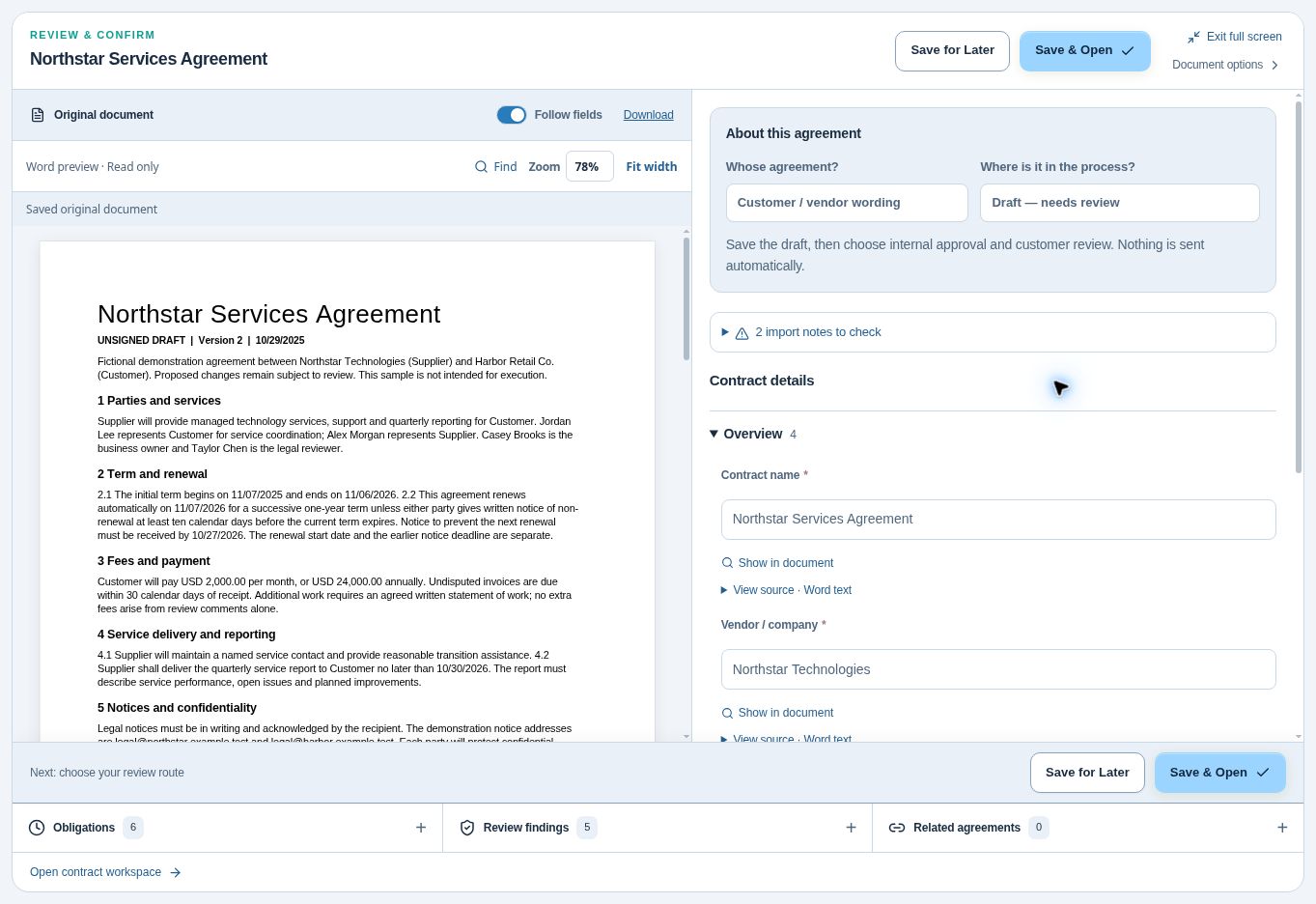
- Capture the unit. Describe the charge as a monthly managed technology service, currency USD, quantity one per monthly service period and unit rate 2,000.
- Check the annual equivalent. Multiply the monthly fee by twelve to reach 24,000. Store or describe the annual amount as an equivalent so nobody adds both numbers together.
- Record the trigger. The sample clock runs from invoice receipt. Give the invoice reviewer a place to supply the actual receipt date and note whether any amount is disputed.
Use pricing tables and payment milestones where appropriate
Use the agreement pricing schedule for quantities, rates and recurring charges. One line can carry Northstar's monthly base fee. If an order includes a separately authorized implementation fee, give it a separate line and a one-time frequency. Check the draft output against the saved schedule before circulating new terms. Contract pricing tables
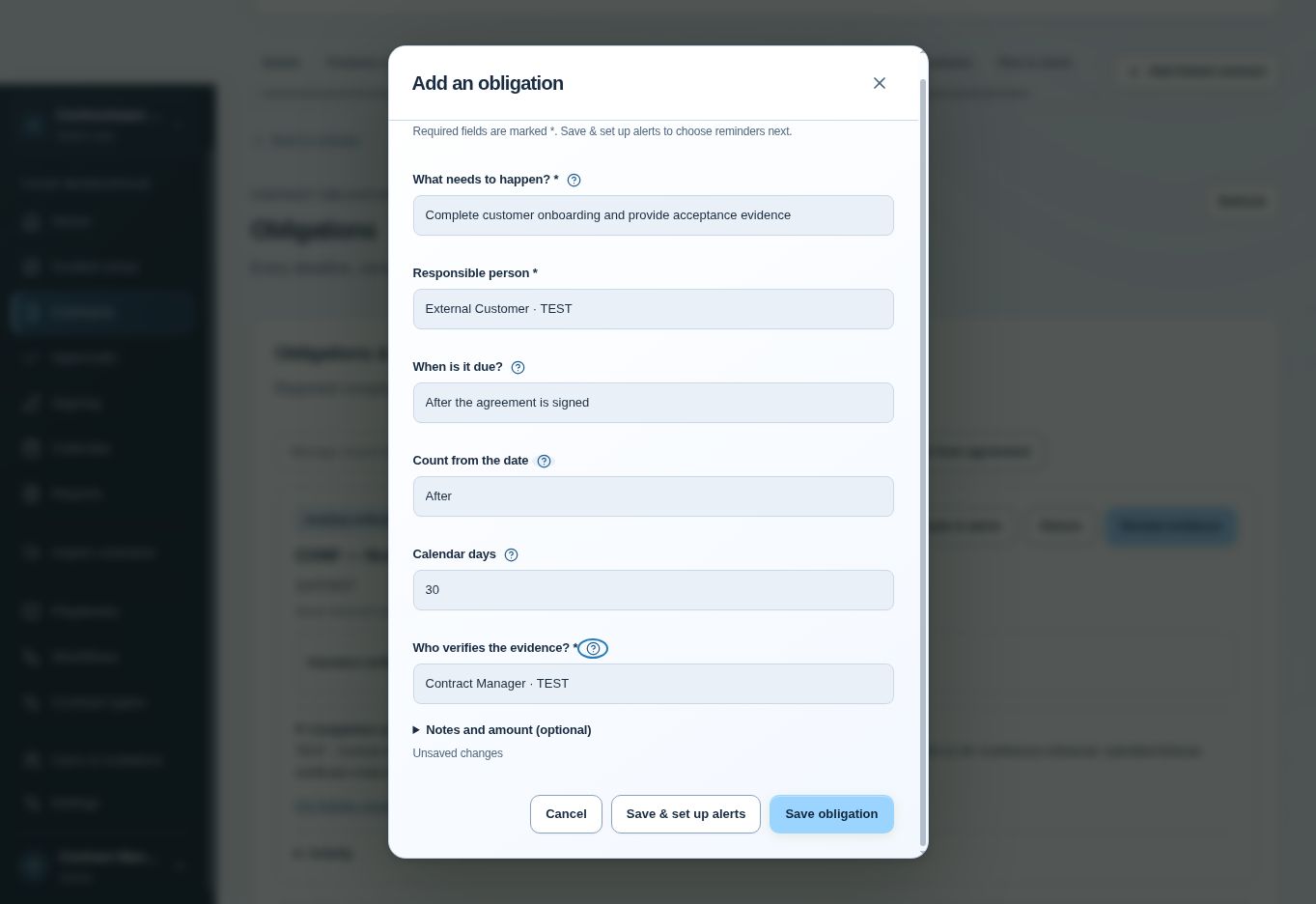
In the separate Add an obligation example, When is it due? shows After the agreement is signed, Count from the date shows After, and Calendar days shows 30. The example assigns customer onboarding and has a separate Who verifies the evidence? field. It demonstrates exactly where a plausible-looking 30-day rule could start from the wrong event if copied to Northstar.
Check your proposed payment milestone by reading its full sentence aloud. If actual invoice receipt is the required trigger, retain the receipt evidence and base the schedule on it. If your configuration cannot represent the precise event, assign a controlled manual follow-up with an owner. A guessed signing offset would produce a date Finance cannot defend. Contract payment milestones
Link each material value to the source
For Northstar, record the agreement title, source version, section 3 and the monthly fee wording beside the pricing basis. Keep the proposed insurance edit outside the financial baseline. If a fee depends on approved additional work, preserve the separately authorized change and its effective period so the reviewer can establish why the scheduled amount changed.
Build one reference for each separate source of truth. The contract source supports price and terms. An authorized invoice extract supports what the supplier charged. A credit memo and Finance's application record support the outcome. Use references with appropriate access so readers can find the evidence without distributing whole accounting files.
Track events and investigate variance
Review due milestones and supporting evidence
Use twelve equal monthly service periods in the following simulation. There is one base service unit per period and no tax, proration, foreign exchange or usage charge. Number the periods M1 to M12 to avoid inventing calendar-month billing terms for Northstar's November 7 start. The source draft remains unchanged throughout.
For one sample invoice, assume receipt on May 4 and that the practice rule counts May 5 as day one. Thirty calendar days gives June 3. Preserve the receipt date and invoice reference beside the expected date. An issue date of May 1 cannot establish receipt. Ask Finance how it records the actual processing and payment dates.
Review what a completed milestone means before advancing a dependent obligation. If it means “finance evidence verified,” the assigned reviewer needs the designated accounting evidence. An email saying the invoice was forwarded to Accounts Payable establishes only that handoff.
Compare the contractual baseline with finance-supplied actuals
Build a separate practice schedule named Northstar invoice simulation. For the first pass, twelve service periods at USD 2,000 give USD 24,000 expected. For the second pass, introduce a fictional authorized change, CH-01, increasing the fee by USD 100 for M7 through M12. This hypothetical change exists only in the exercise.
Six periods at USD 2,000 give USD 12,000. Six periods at USD 2,100 give USD 12,600. The adjusted expected total is USD 24,600. The practice invoice register contains these amounts except that M9 is invoiced at USD 2,250. Comparable invoices therefore total USD 24,750. The positive USD 150 variance belongs to M9.
Reconcile a year of service charges
Northstar training simulation in USD. Twelve equal monthly periods, one service unit each, with no tax or proration. CH-01 and the invoice entries are fictional.
- $24,000Original basis
Twelve service periods at $2,000 give the original annual baseline.
- $24,600Adjusted expectation
In the exercise, authorized change CH-01 adds $100 to each of the final six periods.
- $24,750Comparable invoices
One invoice includes an additional $150 with no supporting change. Investigate that single line.
- $24,600Net after applied credit
Finance verifies that a $150 credit applied to the disputed invoice. The net variance is zero.
These figures describe expectations and invoiced charges. Settlement requires separate payment evidence.
Record discrepancies without claiming the CLM executed payment
Create one discrepancy entry. Identify the agreement, M9, the invoiced USD 2,250, the supported USD 2,100, the USD 150 difference and CH-01. Assign Procurement to request the missing support and Finance to confirm the accounting disposition. Record the consultation date and next follow-up.
In the completed simulation, the supplier issues credit memo CM-09 for USD 150. Verify the memo, its invoice reference and whether Finance applied it. A credit offered in correspondence remains open. Once Finance confirms application, net invoiced charges are USD 24,600. This settles the exercise variance and still leaves payment status dependent on the accounting record.
Produce a useful financial review
Filter agreements by category, owner and decision date
Start with the decision you intend to make. For a category meeting, select supplier agreements with comparable scope, the relevant business owner and upcoming decision dates. Include who can authorize a change and the deadline for delivering a notice. A contract expiring in December can have an October decision cutoff that matters more to the agenda.
Identify omissions alongside totals. Suppose nine agreements fit the scope but one lacks a verified currency and another lacks its current order form. Show seven comparable agreements in the calculated total and explain the two open items. Assign each omission to an owner instead of silently counting missing amounts as zero.
Show assumptions behind totals and scenarios
Put the question, currency, period, population, included charges and evidence cutoff directly above the total. Specify how you treated unsigned drafts, terminated agreements and optional renewal years. For a management scenario, show which assumptions change and preserve a copy of the original basis.
Try a sensitivity check on the Northstar simulation. If the hypothetical USD 100 change started in M8 instead of M7, five increased periods would add USD 500 and the adjusted expectation would become USD 24,500. Showing that calculation makes a dispute about one effective month easy for a reviewer to isolate.
Assign follow-up for leakage and verify the result
Give each open item a specific decision. “Avery in Procurement to obtain written support for the M9 variance by Friday” is actionable. Pair it with the evidence that closes it. Here, closure requires either an authorized change covering the amount or a credit and application verified by Finance.
After closure, identify whether a process change would prevent recurrence. A pricing change with no effective service period suggests a data-quality fix. A duplicate supplier file suggests an identifier problem. Use the review to remove one recurring cause and return next month to see whether new exceptions of that type declined. Finance contract management
Practice handing Finance a reproducible reconciliation
Give a colleague the twelve-period simulation without totals. Ask them to reconstruct the USD 24,000 original basis, the USD 600 authorized increase and the USD 150 variance. Have them identify the minimum documents needed to move the final figure from an expectation to a confirmed net charge.
For an advanced exercise, recompute Birch Labs' discounted-unit example with only 600 units. The price benefit becomes USD 1,200. If the same USD 900 fee and USD 500 incremental internal cost apply, the net effect is an additional USD 200 cost against comparable old terms. The normal review should explain why a lower unit price stopped producing a net benefit.
John's Builder Note
My first question about a spending dashboard is whether I can explain one row. Pick an invoice that looks wrong and follow the price back to the agreement. A simple report that gets you there in a minute earns trust. Another decimal place on the total contributes little when nobody can identify which version supplied the rate.
Questions from the field
Should I put a projected renewal into committed spend?
Show the projection separately with its assumed term, rate and decision date. Ask the contract owner which events make future charges binding and ask Finance how its commitment report treats them. Keeping the scenario identifiable lets management model renewal choices without losing the current obligation.
What if the supplier disputes the credit after quarter end?
Preserve the period, invoice, disputed amount and communications. Update the owner and next action. Finance determines how to present open amounts at its reporting cutoff. Keep any later settlement linked to the original issue so a second quarter's report does not claim the same outcome twice.
Optional knowledge check
Choose your answer, then open the explanation.
Show answer
No; payment requires separate accounting evidence. A contractual schedule and actual payment are different records. Reconcile with authorized finance evidence.
Show answer
Because mixed currencies cannot be added meaningfully without a defined conversion. Any converted total needs an exchange-rate source, date and method; otherwise the aggregate is misleading.
Show answer
A defined baseline, attributable change and verified result. Negotiated or theoretical savings and realized outcomes need separate definitions and evidence.