 ContraxAware
Advanced chapter 18 of 18
Advanced Contract Review Playbooks
Build a compact, role-aware playbook with preferred positions, fallbacks and explicit escalation authority.
Executive summary
- Start with three decisions. Build the first playbook around insurance, renewal notice and invoice payment. Each entry should tell a reviewer the preferred outcome, the acceptable exception and who can decide.
- Record all six policy elements. Give each entry a preferred position, pre-approved wording, delegation, fallback position, escalation trigger and severity or risk rating. Add the reason and evidence where they affect judgment.
- Keep buying and selling separate. A customer asking for insurance and a supplier promising to carry it are making different decisions. Select the organization's role before applying a rule.
- Test the whole agreement. A clause may match familiar wording while a definition, exclusion or missing exhibit changes its effect. A finding supplies a review question. An authorized person decides what happens next.
Part A · The Why
Choose the policy scope
Agreement type, buyer or supplier role and jurisdiction
Write a scope sentence before the first rule. State which company entity is acting, whether it buys or supplies the service, which agreement type is covered, and which jurisdictions or exceptions need specialist review. “US domestic managed technology services purchased by our operating company” gives the first playbook a manageable boundary. An employment agreement or international distribution deal belongs elsewhere.
One company can wear several hats. A supplier may buy a component while selling the final service. Apply the relevant position to the actual obligation and counterparty in each agreement. A clause saying “Customer shall maintain insurance” imposes a duty on the customer even if the same company normally buys contracts that impose it on suppliers.
Give the reviewer an outcome for missing scope information. If the entity or contracting role is unclear, obtain the correct record or authorized clarification. Copying the playbook used for the most recent deal can reverse the position. The first question in a review should establish whose promise is being examined and for whose benefit.
Business objective behind each clause position
Ask the owner what the company wants to achieve. “Net 30” is shorthand for several possible positions. Accounts payable may need time to validate a proper invoice after receipt.
Finance may care about keeping disputed charges out of the payment clock. A rule searching for the number thirty can miss both objectives.
Write an objective that survives different drafting. In the training buyer playbook, the payment goal is time to check an undisputed charge after it arrives. The renewal goal is to preserve a workable decision window.
The insurance goal is evidence of an appropriate coverage commitment for the service exposure. These are separate objectives with different decision owners.
World Commerce & Contracting's contracting principles offer an industry starting point for commercially workable positions. The terms a particular company adopts still depend on its authority, risk appetite, transaction and legal setting. If you borrow a principle, record which part the organization actually adopted. WorldCC Contracting Principles
Legal authority, commercial delegation and risk ownership
Separate authorship from authority. Counsel can approve the form of wording. Finance can determine whether the business can absorb a timing concession.
A risk manager can judge whether the insurance evidence fits the exposure. A business owner may be accountable for the resulting operational commitment. Record the specific authority held by each reviewer.
A delegation should identify the role, the precise deviation it can accept, prerequisites, financial or other limits, and evidence the decision was made within scope. “Ask Legal” is too broad to run. “Risk lead verifies the exposure conditions, then the designated procurement manager may accept the specified fallback on this draft” gives people an executable sequence.
Also define what the administrator can do without accepting risk. They can identify the clause, compare wording, record a deviation, request missing evidence and send the issue to the named role. Authority to maintain the playbook's records supplies no blanket authority to accept the counterparty's proposed change.
Define a complete playbook entry
Preferred position and pre-approved wording
The preferred position describes the desired outcome in plain language. Pre-approved wording gives the reviewer text approved for use within a defined scope. Record the wording version or effective date and who approved it. If a rule needs several separate qualifications, retain the complete provision or a controlled reference to it.
Test a plain-language paraphrase. A reviewer should still recognize a matching commercial position when the counterparty uses different words. At the same time, a familiar opening sentence may have an exception later in the paragraph. Evaluate the entire relevant provision and its cross-references before treating the preferred position as met.
Use a maintained source for approved wording. A sentence copied from an old negotiation could be a concession limited to that account. A new clause owner should be able to establish whether the language is an approved starting point, an acceptable fallback or a historical exception granted once. Each has a different use.
Delegation, fallback and escalation trigger
A fallback is a position the organization may accept under stated conditions. It needs both a boundary and someone empowered to use it. An escalation trigger tells the reviewer where delegated judgment ends. Include ambiguous language, missing documents or crossed limits when those prevent the reviewer from deciding safely.
Consider a buyer that prefers payment thirty days after receiving an undisputed invoice. It may delegate acceptance of twenty to twenty-nine days when accounts payable confirms its processing capacity. A promise to pay in twenty days after invoice date changes the trigger as well as the number. Check whether the approved delegation covers that different trigger.
Record the escalation destination and the decision requested. “Outside policy” accurately describes the problem but leaves a queue with no owner. A useful instruction identifies Finance for a cash-timing decision, counsel for disputed-charge wording, or both where the issue crosses those boundaries. Include a business deadline and the effect of waiting.
Severity, rationale, exceptions and required evidence
Make severity describe the review need. An urgent or high-severity finding may require a named reviewer before release. A moderate deviation may be delegated subject to evidence.
A low-severity observation can still require correction if it misidentifies a party. Use words explaining the expected action, alongside any color or number.
Business impact is a separate judgment. A missing service-level remedy might affect a discretionary pilot little and a production-critical service substantially. Capture the facts that change the impact.
Avoid averaging three low issues and one unresolved release condition into a comfortable-looking score. The release condition remains open until an authorized person resolves it.
Specify what closes the finding. Options may include corrected wording, evidence that the preferred position is present, an acceptance within delegated authority, or a recorded decision by the exception authority. A certificate attached to a record evidences a document received. Whether it answers the relevant coverage question depends on its contents, the contract and the qualified reviewer.
Govern judgment and consistency
Severity versus business impact
Use two questions in a calibration exercise. First, what action does the policy require for this departure? Second, what commercial or operational harm could it cause here?
Two reviewers can agree that an exception needs Finance while reasonably disagreeing about its likely cash impact. Keep their disagreements visible until the appropriate person resolves them.
In a fictional purchase, shortening a payment term from thirty days to twenty accelerates when cash leaves the business. The invoiced amount stays the same. An analyst who labels the whole contract price as a loss has confused timing with cost. Ask Finance to quantify a relevant impact or document why a qualitative assessment is sufficient.
Record confidence in the underlying facts separately. A missing exhibit leaves the reviewer with an evidence gap about exposure. The defensible outcome is an information request, a provisional assessment clearly marked as such and an owner. Revisit the rating when the evidence arrives.
Interacting clauses and aggregate exposure
Read the definitions that give the clause its reach. A liability cap applies to some claims, unless the agreement excludes them. An indemnity can bring particular events into an exception to that cap.
Insurance can respond to some losses under the policy's terms. Working out the organization's exposure requires reading how those provisions interact.
Make a short event narrative. Who suffers the loss? Who is making a claim against whom?
Which obligation could apply, which exclusion or cap might apply and what is known about actual coverage? Counsel and the insurance specialist can evaluate the assumptions. The administrator's contribution is to connect the relevant text and preserve the open questions.
Watch for a time mismatch too. A promise might survive the contract term while an evidence obligation calls for an annual certificate. The contract owner will need updated evidence for subsequent periods. Connect the review finding to a prospective post-award owner, conditional on the contract being finalized in that form.
Version owner, review cadence and validated examples
Name the owner who maintains each rule and the authority who can approve revisions. Retain the old version, effective dates, decision history and example cases. When a new policy is approved, decide explicitly how it applies to drafts already under review. The point is to explain historical decisions in their original context.
Assemble examples from training documents or approved, appropriately handled source material. Include a clear match, an acceptable fallback, an escalation and an ambiguous case. Have two qualified reviewers classify them independently. If they repeatedly disagree on the same sentence, revise the rule or its examples before training everyone else on it.
A fictional case of an accidental renewal policy
A mid-market services buyer builds its first playbook from a successful deal. That deal accepted automatic one-year renewal with sixty days' advance notice because the business owner guaranteed a special renewal review. The next administrator treats the signed clause as the general company standard. Three new buyers copy the term without arranging that review.
The contracts lead interviews the original approver and separates the historical exception from the usual position. The working group prefers affirmative renewal. It permits a limited automatic-renewal fallback on specified conditions and assigns the business owner a follow-up for each acceptance. The sixty-day concession remains attached to the original transaction.
Before releasing the revised playbook, the group tests three agreements. One renews only by written agreement, one gives a ten-day exit cutoff and one requires notice sixty days in advance. A reviewer must explain each decision, identify the responsible authority and state the next operational action. A label without those details fails the exercise.
Part B · The How
For a playbook trial with AI contract management software, select a clause that uses different wording from the preferred version but meets the same requirement. Ask the reviewer what would justify an escalation.
Build a small playbook in ContraxAware
Start with insurance, renewal notice and payment terms
Use a training playbook for the buyer of managed technology services. ContraxAware supports editable playbooks based on starter rules, a reference agreement or the organization's requirements. Begin with these three topics and save the approved training positions together. If starting from a reference, review every suggested rule individually before treating it as a standard. ContraxAware contract review playbooks
- Define the scope. Use the purchasing entity, buyer role and service type from the training case. Label the playbook as a practice policy.
- Identify the owners. In this exercise, Risk owns insurance, Procurement owns the renewal process, and Finance owns payment timing. Counsel reviews wording and legal questions.
- Set the comparison basis. Use the applicable saved draft, including the referenced schedules supplied with it. Record missing pieces before classifying an apparent departure.
Capture the six required policy elements
The following three entries are complete examples for the exercise. The quoted wording illustrates what a fictional company could approve for its training set. Your organization needs its own approved terms, delegation and evidence requirements.
Insurance. The buyer prefers at least USD 2 million in commercial general liability coverage per occurrence during the service term. The practice wording reads, “Supplier will maintain commercial general liability insurance of at least USD 2,000,000 per occurrence throughout the service term and provide evidence before services begin.” The proposed fallback is USD 1 million per occurrence for low-exposure remote work under USD 25,000 in initial-year fees.
The designated procurement manager can accept that fallback only after the risk lead documents that the work qualifies and the relevant evidence has been checked. An unspecified coverage basis, onsite work or missing risk confirmation triggers referral to Risk. Assign high priority before release if the coverage basis or required evidence remains unresolved. Record the decision, source and reviewer.
Renewal notice. The buyer prefers affirmative written renewal. The sample wording reads, “A further term requires written agreement by both parties.” The fallback permits one-year automatic terms when the minimum contractual advance notice required to prevent renewal is fifteen calendar days or less and the business owner accepts responsibility for the decision window.
The designated procurement manager can accept that fallback after checking notice method and recipient, calculating the receipt cutoff, and recording the business owner's agreement. A longer lead time, uncertain delivery terms or absent owner goes to Procurement and the appropriate legal reviewer. Treat a confirmed delegated fallback as moderate and an unresolved notice mechanism as high before the first decision window.
Payment terms. The buyer prefers thirty calendar days from receipt of an undisputed invoice. The practice wording reads, “Customer will pay undisputed invoiced amounts within thirty calendar days after receipt of the invoice.” The fallback allows twenty to twenty-nine calendar days on the same basis. The procurement manager can accept it after written confirmation from the accounts payable lead that the proposed timetable can be met.
A shorter period, advance payment, a different clock or changed treatment of disputed amounts triggers Finance review, with wording questions referred to counsel. Rate a complete match as routine and an unsupported cash commitment as high pending a decision. Retain the invoice trigger alongside the day count. Otherwise another reviewer may mistake ordinary wording for the approved fallback.
Separate buyer-side and supplier-side positions
Create a separate practice rule for Northstar's perspective as supplier. It may prefer a USD 1 million per-occurrence commitment and consider USD 2 million only after its risk lead verifies the appropriate coverage basis, evidence and cost. A procurement manager acting for Harbor cannot grant approval on Northstar's behalf. The two reviews can reach different dispositions on the same proposed figure.
Payment makes the difference easy to see. A fictional supplier might prefer payment within fifteen days of receipt and require credit approval for thirty days. The buyer's preferred thirty-day term could therefore be a supplier-side fallback. Give the reviewer the selected role, authority and policy version as part of the result when comparing saved wording. ContraxAware AI contract review
Review the Northstar sample
Compare the proposed insurance change with the applicable role policy
Begin in Northstar's editor at Suggest changes · redline. Read clause 6.1 in the document and the change card attributed to Taylor Chen. The card shows USD 1,000,000 replaced with USD 2,000,000. The Draft indicator and the visible tracked change establish the review context for this screenshot.
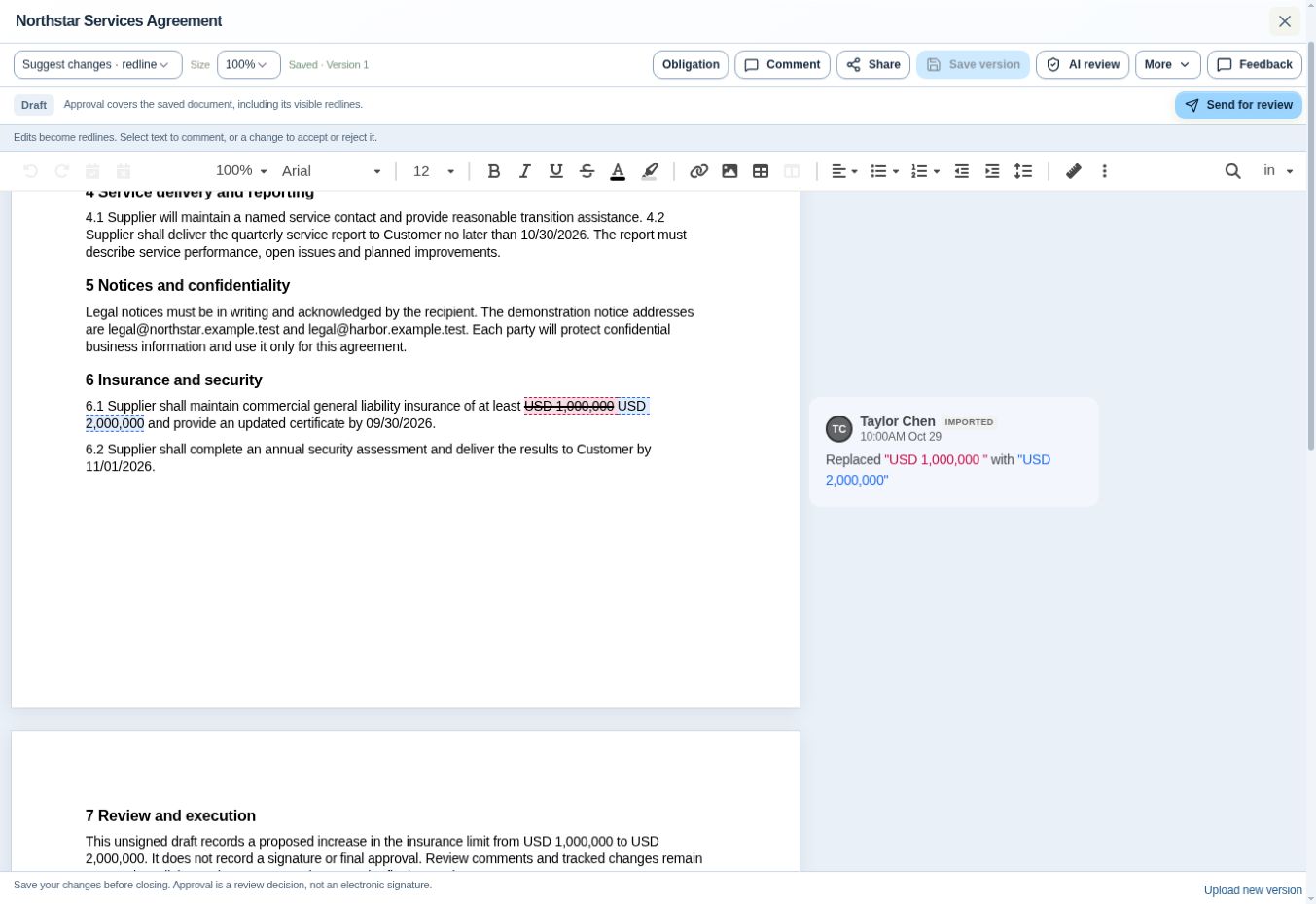
Compare the wording with the buyer practice rule. The proposed number matches the preferred amount, but the displayed sentence does not specify a per-occurrence basis. It also calls for an updated certificate by a specific date, while the example preference asks for evidence before services begin. Look for definitions or controlling schedules before deciding whether the complete position is met.
Why this matters. Selecting the larger number would miss both the missing basis and the timing question. Record the proposed amount and open questions separately. Leave the final obligation for the version the parties ultimately execute. ContraxAware contract redlining and negotiation
Link findings to the exact source and approved guidance
- Identify the source. Record Northstar Services Agreement, the saved version shown in the editor, clause 6.1 and the relevant proposed replacement.
- Identify the policy. Record the covered entity, buyer role, insurance rule and playbook version used for comparison.
- State the issue. The proposed amount is USD 2 million. The displayed clause leaves the coverage basis unstated and sets a dated certificate requirement. Check the rest of the agreement and its attachments.
- Name the decision. The risk lead should confirm the basis and evidence requirement. Counsel can determine the appropriate wording if clarification is necessary.
The editor shows AI review. A finding from that review can help locate language. Examine the cited source and approved rule before entering the disposition.
Treat the imported change card as evidence of a proposed edit. Final acceptance and verification of coverage require their own evidence.
Route the exception to an authorized role rather than inventing consent
Prepare a short handoff for Risk with both versions of the amount, the clause location and the missing basis. Include the decision needed before the draft can proceed and who owns the deadline. If Risk obtains additional wording or evidence, add its reference and return the decision to the authorized role.
If a fallback is approved, record which conditions were met and which obligations a future contract owner must track. If approval was limited to this deal, retain that boundary. The next administrator who sees the same wording should be able to tell whether a fresh escalation is required.
Validate and improve the playbook
Test compliant, fallback, escalated and ambiguous examples
Test the payment entry with fictional sentences. Thirty days after receipt of an undisputed invoice matches the preference. Twenty-five days on the same basis enters the conditional fallback and needs accounts payable confirmation.
Ten days prepaid requires Finance. “Payment follows Schedule B” with no Schedule B in the packet remains unresolved.
Four payment clauses, four different decisions
Fictional buyer playbook for managed services. The preferred position is payment of undisputed amounts thirty calendar days after invoice receipt.
- Preferred30 days from receipt
The clause preserves the undisputed qualification and receipt trigger. Record its source and the policy version.
- Conditional fallback25 days from receipt
The same qualifications apply. The designated procurement manager needs written confirmation from the accounts payable lead.
- Escalate10 days prepaid
Advance payment is outside the delegation. Finance must decide on the changed cash commitment.
- Obtain evidenceMissing Schedule B
The clause points to an unavailable schedule. Request it before classifying the payment term.
Start with the basis and qualifiers as well as the number. A routing decision still needs the appropriate authority.
For each outcome, record the identified wording, required evidence, reviewer and release condition. Swap the last two examples between trainees. One presents a clear out-of-policy term.
The other lacks the information to classify the term at all. Both may need attention, but the next person and the next request can differ.
Check AI findings against human-reviewed labels
Have two reviewers label the four examples before running the selected playbook. Compare the automated findings with those labels. A tool that flags all four as payment clauses has recognized the topic.
It has still to distinguish a match from a delegated exception or missing evidence. Record classification errors and missed qualifiers separately.
Include one cross-clause test where an apparently compliant thirty-day clause starts the clock at invoice date through a definition elsewhere. Count a missed trigger as a meaningful failure even when the number is correct. The person responsible for a final decision must be able to retrieve the wording that changed the result.
Revise policy with approval and preserve prior decision context
If three reviewers misclassify the same sentence, inspect the rule. It may lack a defined trigger, an example or a delegation condition. Record the proposed correction, approval and effective date, then rerun the difficult examples. Keep the earlier version linked to decisions made while that version governed the work.
Practice testing the three entries together
Hand a colleague the three entries, the Northstar draft and the buyer role. Ask them to produce a decision record for each. Look for the insurance basis and evidence questions, the conditions attached to the renewal fallback, and the receipt trigger plus undisputed qualification for payment. A good answer identifies the next owner wherever facts or authority are missing.
For an advanced challenge, consider a separate fictional incident with a USD 100,000 general liability cap, an indemnity potentially carved out of that cap and a USD 1 million insurance commitment. A claimant alleges a USD 600,000 loss. Determine which clauses and policy evidence counsel and Risk would need.
Adding the cap to the insurance commitment, or assuming the insurer pays the claim, cannot establish the answer. Record the unresolved aggregate exposure and obtain an authorized decision.
John's Builder Note
I would rather give a new reviewer three positions they can explain than a library of clauses whose owners nobody remembers. The test is simple. Hand the reviewer a gray-area example and watch whether they can find the person entitled to decide it.
Questions from the field
Can the same person maintain a rule and approve a deal?
They may have both assignments if the organization's authority policy permits it. Document which role they exercised, what decision they made and which independent checks the transaction requires.
Does a previously accepted exception become a fallback?
Only after the policy owner evaluates it and the required authority adopts it as a reusable position. Keep transaction-specific approvals attached to their scope and version until a policy change is authorized.
Optional knowledge check
Choose your answer, then open the explanation.
Show answer
Decision rules, authority, fallbacks and escalation. The playbook tells a reviewer what to do with a deviation and who can accept it, not just what wording exists.
Show answer
No; obligations and risk allocation can change with the party’s role. The organization’s role changes the commercial objective and acceptable allocation; the approved policy should reflect that.
Show answer
Review the combined effect and escalate outside delegated authority. Clause-level checks do not replace analysis of interactions and total exposure.