 ContraxAware
Core chapter 2 of 18
Centralizing the Repository and Migrating Legacy Contracts
Build a controlled migration that preserves originals, relationships and unresolved exceptions.
Executive summary
- Count the source files first. Give every file a stable identity before anyone renames, combines or imports it. You need a way to explain where every file went.
- Keep documents in context. An order, amendment or exhibit can govern real work alongside its parent agreement. A shared supplier name is weak evidence that two files are duplicates.
- Separate receipt from verification. A successful upload tells you that the system received a file. A reviewer must still establish its identity, contents, status and relationship to the other records.
- Set a release standard. Agree which exceptions block operational use and who can accept a limited handover. Keep the source available under the organization’s records policy.
Part A · The Why
Inventory before import
Find executed originals, drafts, exhibits and amendments
Start with a request a colleague might make on Monday morning. “Which agreement controls the maintenance rates at our East plant?” One folder contains a signed master, another contains a rate sheet, and the plant manager has an amendment that changed the weekend rate. Moving the first folder would produce a tidy, incomplete answer.
Pick a scope you can describe in a sentence. For example, migrate the current facilities agreements for three operating sites, their amendments, and draft replacements still under review. List exclusions and the person responsible for the next wave. A supplier spreadsheet can reveal missing relationships, although the spreadsheet alone cannot establish that you have found the agreements.
Give each inventoried file an identifier, even when its filename looks useless. Record its original location, filename, format, approximate size, custodian, access restrictions and apparent document role. Treat the role as provisional until someone reads the file. A filename ending in “FINAL” tells you what someone called it.
Establish provenance, permissions and legal-hold constraints
Provenance answers two practical questions. Where did this copy come from, and can the organization show how it arrived in the repository? Keep the source location or system identifier, collection date and person or process that collected it. Record later improvements, such as a searchable rendition, as separate events. That history matters when two teams insist that their copies govern.
Ask the records owner which source locations may be copied, who may see each set and whether preservation instructions apply. If a custodian flags a hold or a restricted negotiation, involve the designated records or legal lead before changing location, access or disposition. A broad permission to migrate supplier files does not authorize publication to every department.
Inventory metadata can itself reveal a sensitive matter. Give the intake list appropriate access and use an internal reference in a general exception log if the title identifies a confidential project. A records-management framework helps separate capture, ongoing use and disposition when designing these decisions. NARA’s federal electronic records requirements provide one such framework for federal agencies.
Choose an owner for every exception
An exception needs a question that a person can answer. “Bad contract” gives the next administrator nothing to do. “Page four is missing from the signed December copy. Facilities Operations will request a complete scan from its records custodian by Thursday” gives someone an assignment and a completion test.
Separate the person researching the problem from the person authorized to accept a limited release. A coordinator can locate a missing exhibit. The facilities lead may decide whether staff can use the remaining record for contact information while rates are unresolved. Capture the restricted use explicitly so the contract register cannot lend certainty to an unverified price.
Prioritize by the decision at risk. A missing page that defines next week’s cancellation rights deserves earlier attention than inconsistent capitalization in a supplier’s display name. Review unresolved items with the people who can obtain evidence. Moving them between administrative queues changes little.
Clean data without rewriting history
Duplicate detection versus legitimately different versions
Compare content in stages. Exact file matches can be detected through byte comparison or a digest from an approved records tool. Record which source occurrences contained that copy. The same bytes in the field office and in Legal can be useful evidence of collection coverage even when one destination copy serves both.
Different bytes establish only that something differs. A scanner can add a cover page to an otherwise identical agreement. A countersignature can also be the only visible difference between a draft and the copy you need. Check page count, signature pages, attached schedules, effective dates, identifying numbers and business context before combining records.
Set aside near matches for review. Keep the original file in its received form and write the proposed relationship beside it. If nobody can establish which version governed a particular service period, tell the business exactly what is uncertain. A larger file size, newer modified date or more polished layout is a poor tie-breaker.
Master agreements, order forms and amendment relationships
Read the reference in the document. An order may name a master agreement by date, parties and number. An amendment might change only one location or only orders signed after a specified date. A supplier with multiple subsidiaries or regional master agreements makes a company-name match particularly risky.
For each link, retain the parent identifier, child identifier, relationship and supporting wording. Distinguish an attachment that forms part of one package from a separate order with its own owner, term and renewal. Decide how each should appear in a portfolio count. An administrator should be able to move from an order to the controlling master and return to the order without guessing from filenames.
Try the question in reverse. If the master expires, which open orders need review? A link gives the administrator the documents to inspect. It does not determine the legal effect of expiration on those orders. Assign that interpretation when the documents give different answers or contain an unfamiliar precedence rule.
OCR quality, naming and required source metadata
Searchable text is an aid to reading. Optical character recognition can turn a faint digit in a notice period into a convincing wrong number. Check a high-impact item against the visible page even if the generated text reads fluently. Treat blank search results cautiously when a scan is skewed, handwritten or missing pages.
Keep the received original and identify any searchable or cleaned version as a derivative. Give the derivative a clear relationship to its source. If the source arrives password-protected, route it through the authorized custodian. A staff member should be able to tell why a readable version exists and locate the original if the conversion is questioned.
Choose display names that distinguish records without carrying the whole filing system in their titles. A useful name combines the counterparty, agreement role and a distinguishing date or identifier. Preserve the original filename separately. This lets the administrator simplify a messy listing while still answering a request from someone who knows only the old name.
Prove migration completeness
Source inventory and destination reconciliation
Count like things together. A source file is one item collected. A destination agreement is a business record. A signed agreement with two exhibits might contribute three collected files and one operating record. Decide on these units before the first meeting about progress.
Give every source item one primary disposition, such as accepted original, confirmed extra copy, unresolved or outside scope. Keep the destination identifier wherever one is known. A report that says “100 percent accounted for” may include unresolved items. Report how many records are ready for a specific operational purpose alongside the inventory result.
Run the comparison in both directions. Find source items lacking a destination or an explicit reason. Then find destination records lacking a source item or a documented reason for creation. The second pass catches duplicate imports, preexisting records and accidental splitting of a supporting document into a separate agreement.
Sampling by risk and document quality
Review the full population of time-sensitive or financially material exceptions according to the release standard. Add a sample from ordinary records, including clean files. A sample of only obvious problems will not tell you that a supposedly reliable import mapped the wrong owner across a whole department.
Make sampling repeatable. Save the list of record identifiers, the selection method, the fields checked and the result. If a sampled field fails, look for a shared cause before deciding how far to expand review. A reversed month and day across one source system warrants a check of that system’s ambiguous dates wherever they occur.
Ask a second person to retrieve one agreement using the new system and explain the evidence behind a key fact. Watching someone find the actual governing rate in an unfamiliar record tests something a file count cannot.
Cutover, rollback and retention of migration evidence
State when the team should begin updating records in the new repository. During a long migration, a counterparty may sign a replacement or send an amendment after the source inventory was captured. Give one person responsibility for recording changes between that snapshot and cutover and reconciling them before release.
Plan how the business will work if a batch fails. Pause the affected import, retain the source and mapping log, identify which records were created, and decide how existing edits will be preserved. A blanket rerun can create another set of destination records. Verify the identity of already imported items before retrying the remainder.
Keep the source inventory, disposition log, mapping decisions, sample results and release approval together. Original storage can contain material subject to separate retention or preservation instructions. Leave disposition decisions with the responsible records owner and record what was authorized.
A fictional case at Alder Mill Services
Alder Mill’s facilities team counted twelve collected files and expected twelve new agreements. Its executive sponsor saw five new records and thought seven contracts had vanished. The administrator asked for a file-by-file explanation before authorizing another import.
Seven source files belonged to five agreement records. Two additional files were byte-identical copies already accounted for. One image was too faint to classify, one amendment referenced a missing parent, and one brochure fell outside scope. The intake ledger therefore reconciled twelve of twelve items. Two exceptions still needed work.
The sponsor wanted to know whether a plant could rely on its weekend rates immediately. That question exposed the difference between a complete inventory and an operational release. The plant agreed to use only the verified rate package. Its manager opened a separate action to recover the missing parent before anyone used the orphan amendment for billing.
Where the twelve pilot files went
Alder Mill’s fictional source inventory reconciles even though two files still need investigation.
- 7 filesOriginal files accepted
Seven files support five agreement records. Redwood’s signed master, exhibit and amendment belong together.
- 2 filesExtra copies traced
A second occurrence points back to each of two already accepted originals.
- 2 filesHeld for evidence
One scan is unreadable. One amendment is missing its referenced parent.
- 1 fileApproved exclusion
A brochure is outside the agreed migration scope. The inventory retains the reason.
7 + 2 + 2 + 1 = 12 source files. Five destination agreement records answer a different counting question.
Part B · The How
Before you migrate a whole filing cabinet into contract management software, pick one amended agreement. Ask a colleague to find the signed original and the amendment that governs today’s price. Record where they get stuck.
Prepare a pilot import
Select a representative small batch
Use fictional files in a training workspace. Recreate the twelve-item inventory from Alder Mill. Label the source items A01 through A12. A01 is the signed Redwood facilities agreement, A02 its rate exhibit and A03 a signed rate amendment. Those three files belong together.
A04 is the unsigned Northstar Services Agreement. A05 is a signed Seaport confidentiality agreement, A06 is a Marlow fleet agreement and A07 is a standalone Wren statement of work. A08 repeats A01 byte for byte and A09 repeats A04. A10 is the poor scan, A11 is the amendment with the missing parent and A12 is the brochure.
Practice the classification before uploading anything. In a live pilot, add a document with restricted access and at least one example from a source that people consider reliable. Agree with the business owner which decisions can be tested using the pilot. This chapter’s sample can test retrieval, grouping and review of draft status.
Map contract types and initial owners
Write the proposed record type and owner alongside each item selected for use. Put Redwood’s exhibit against the Redwood record. Decide how to preserve document-level details that staff need, such as the effective date of a price change. Give Northstar its own draft record and retain its supplier and customer roles.
Have the receiving department confirm its responsibilities. A workspace administrator can load a portfolio yet have no authority to verify a facilities rate or resolve a dispute about vendor identity. Ask the department to name a reviewer and a backup who can retrieve the required source.
Review initial permissions before assigning work. A trainee acting as a general requester should have the access intended for that role. Ask an authorized test user to confirm that the pilot’s restricted material stays within its designated group. Document the result in the pilot log.
Record source counts and sample identifiers
Save the frozen inventory with the batch name, date, source scope and the names of the collector and reviewer. For each source row, reserve columns for disposition, destination reference, reviewer and reason. Keep the original identifier after assigning a cleaner display name.
For example, A08 points back to A01 and the same Redwood destination. A10 carries a reason for being held and the name of the custodian seeking a better copy. A12 has an exclusion reason approved by the facilities lead. Each row still has somewhere to go when the team repeats the count.
Import and review in ContraxAware
Upload supported files with Batch Import
Submit the selected PDF or Word training agreements through the organization’s authorized ContraxAware import workflow. Keep each relationship understandable. If the Redwood exhibit is a supporting document in your design, retain it with its parent using the document or relationship workflow used by your team. Sending it through as a standalone agreement would change the report you intended to build.
Record the batch reference you can retrieve and link the accepted files to the intake ledger. If processing stops, check which files already reached review. Retry only the unexplained remainder once you understand the cause. The product guide describes the supported formats and the review of proposed values. Bulk contract import
Review extracted values beside the document
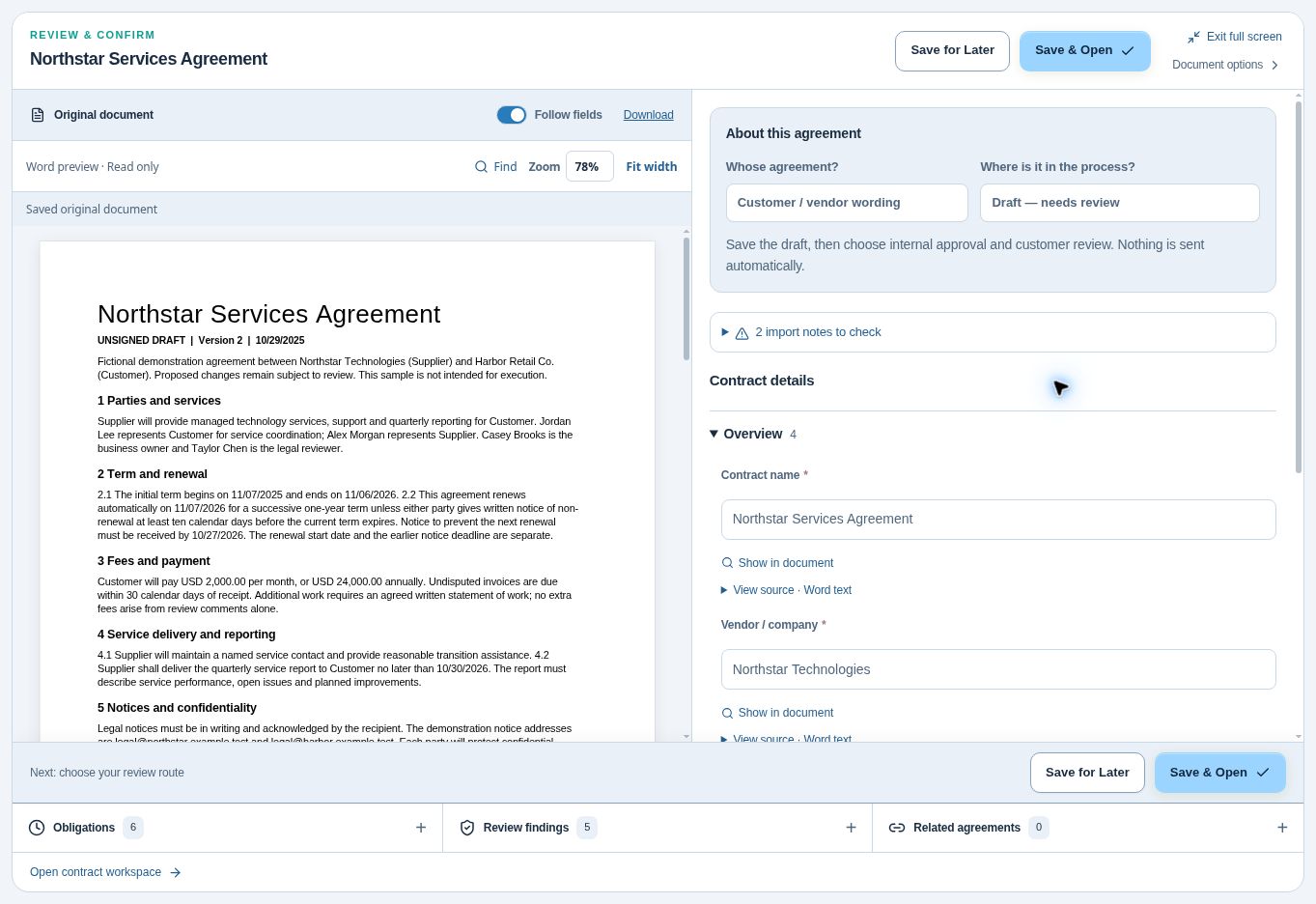
Start the Northstar exercise on REVIEW & CONFIRM. The Original document occupies the left side. On the right, About this agreement shows Whose agreement? and Where is it in the process?. The sample shows Customer / vendor wording and Draft — needs review.
- Read the draft heading and opening sentence in the left pane. Check that the Contract name in Overview matches the title.
- Check Vendor / company against the supplier named in that sentence. Use Show in document under that field when you need its source. Harbor Retail Co. is the customer in this example.
- Open 2 import notes to check. Compare each note with the file before treating the record as ready. Use Save for Later if the review needs more evidence, or Save & Open when ready to continue.
Why this matters. One supplier can be the counterparty across many agreements, and an unsigned draft can carry real-looking dates and prices. Keeping the two identities and the draft state straight prevents a convincing but misplaced record.
Resolve missing parties, dates and unreadable text
Give a reviewer the question at the smallest useful level. If the scan cuts off the effective-date sentence, ask for the complete page and the preceding definition it references. If a document uses a trading name, ask the business owner to identify the legal entity and provide the evidence that connects them.
Set an owner and due date for A10 and A11. For A10, the task finishes when a readable replacement is linked to the original and the relevant fields have been checked. For A11, the task finishes when an authorized reviewer identifies the correct parent or documents why the relationship remains unresolved. A similar supplier name cannot close that task.
Reconcile and hand over
Link related agreements and preserve originals
Open each pilot agreement and locate its source. Follow the Redwood master to its rate exhibit and amendment. Ask a second reviewer to identify the original rate, the revised rate and when the change applies. Have the reviewer cite the document and section used for each answer.
The Northstar import screen also shows Related agreements. Its count is zero in the displayed sample. Treat that as the state of this training record. When linking real documents, verify the reference in the source and record the reason for the link before treating it as operational evidence.
Check counts, spot-check sources and log exceptions
Repeat the two-way reconciliation using the saved inventory. Expect five destination agreement records, seven accepted originals, two duplicate occurrences, two held exceptions and one out-of-scope item. All twelve source items have a disposition. A reviewer can independently locate the accepted original for each of the two extra copies.
Compare the person’s retrieval results with the intended business decisions. Was the rate exhibit easy to find? Can a requester tell that Northstar is a draft before asking Finance to book its annual fee? Correct the record or its classification when a test fails. Repeat the same retrieval test and date the evidence.
Assign remediation and sign off the migration batch
Give the receiving manager a short release statement. Identify the five destination records, their allowed uses, the decisions affected by the outstanding exceptions and the next dates for review. Name the person taking ownership of routine changes after cutover.
Ship that statement with the inventory and acceptance evidence. A month later, a new administrator should be able to explain why the brochure was excluded and where the second Redwood copy went without interviewing the project team. The central contract repository then serves as a place to recover an answer as well as a file.
Practice the excess-record investigation
Suppose the destination list has six pilot agreements. Your intake sheet still expects five. Locate the six destination identifiers and attempt to trace each to a source row. In this exercise the extra record contains only A02, the Redwood rate exhibit. The exhibit is already present in its intended record.
Write a correction proposal naming both destinations, the authoritative home for the exhibit and any notes or access settings that would be lost by a simple cleanup. Ask the authorized administrator to choose the appropriate remedy for the test workspace. Recheck the source link, record count and reviewer access afterward.
For the advanced challenge, assume a colleague has already added a field note to the stray record. A good answer preserves the note, establishes who can see it, moves or references it according to policy and keeps a trace of the correction. Reducing the visible count to five alone earns no credit.
John's Builder Note
Give me the old identity, the new identity and the reason the two belong together. That little row answers more questions during a migration than a progress bar ever will. When someone says the job is ninety percent done, ask which agreement a plant manager can safely use today.
Questions from the field
Should I rename everything before import?
Rename for retrieval where it helps. Capture the original filename and source identity first. A custodian searching for last year’s poorly named file needs a way to reach the cleaned record.
Can we finish a migration while some items are unresolved?
Yes, if the designated owner accepts a defined scope, affected uses are clear, and each exception has a responsible person and due date. Report unresolved items alongside the release so nobody mistakes the handover for complete validation.
What if the source inventory itself missed a folder?
Add a dated supplemental batch and explain how the gap was discovered. Preserve the first report so the team can distinguish the original decision from the later correction. Check other custodians using the same collection method for similar omissions.
Optional knowledge check
Choose your answer, then open the explanation.
Show answer
No; inspect and preserve the relationship. An amendment can change selected terms while the original remains relevant. Inspect content and link the records.
Show answer
Reconciled counts, validated samples and an exception log. Upload success does not prove accuracy or completeness. Reconciliation and source checks are separate controls.
Show answer
Keep the uncertainty visible and verify against a usable source. An invented date creates false certainty. Assign the exception and obtain a reliable source.