 ContraxAware
Core chapter 4 of 18
Alerts, Renewals and Expiration Management
Work backward from the actual notice requirement and manage renewal as a decision, not a reminder.
Executive summary
- Read the clause before setting the clock. Identify what must happen, who must do it, where notice goes and whether the deadline governs dispatch or receipt.
- Protect the decision window. Schedule internal review far enough ahead for negotiation, authority, delivery and a failed first attempt. The expiration date can be weeks or months too late.
- Give each alert an owner and a response. Decide what evidence closes the task and who acts when the recipient is unavailable.
- Close the contract record with evidence. A decision, an outgoing notice, confirmed receipt and the resulting term dates are separate facts. Preserve the evidence that supports each one.
Part A · The Why
Read the timing mechanics correctly
Effective date, term end and renewal commencement
When someone asks when an agreement renews, answer a second question first. Which decision are they trying to make? Finance might need the first day of the new billing term. The business owner might need the last day the company can prevent that term. Operations might be planning the last day of service under the current term.
Read the term provision and any document that changes it. Find the initial term, the current term, the next term and the renewal mechanism. An agreement can renew automatically, require a written election, expire without extension or continue until someone exercises a termination right. Give each type of mechanism a different action in your calendar.
Write a one-sentence rule that another reviewer could check. In the fictional Northstar draft, the initial term begins November 7, 2025 and ends November 6, 2026. The next one-year term would begin November 7, 2026 if the draft terms applied and renewal occurred. Retain the draft designation in this exercise. A printed term does not establish execution.
Notice period, delivery method and receipt requirement
Read the general notices section along with the renewal clause. The renewal provision might specify when notice is due while a second section supplies the recipient, delivery method and evidence of receipt. An amendment, order or recent address update can change what you need. Collect the governing documents before offering an answer.
Translate the clause into a task a colleague can repeat. Who may authorize the notice? Which party receives it, through which allowed channel, at what address, by which deadline? Does the agreement measure sending, delivery, receipt or a defined event? Write down the exact wording for an authorized reviewer if those verbs point in different directions.
Northstar’s draft says written notice must be received by October 27, 2026. Its general notice terms require acknowledgment by the recipient. A message placed in an outbox on October 27 gives you inadequate evidence for that example. Identify the owner who will secure acknowledgment and the person who will decide what to do if receipt remains uncertain.
Calendar days, business days, time zones and exceptions
First determine the unit the agreement uses. Ten calendar days include intervening weekends. Ten business days require the applicable business calendar. A month is not a fixed number of days. Look for language about the counting convention, local closing time, applicable holidays and what happens if the last day is a nonworking day.
Do not silently move a contractual deadline to Monday because your team works weekdays. Keep the contractual event tied to the wording. Choose an earlier internal delivery target that leaves time for the recipient's working schedule. When the provision is ambiguous or the deadline affects an important right, ask the designated legal reviewer to resolve it.
A date-only entry can conceal time-zone risk. For a cross-border notice, record the recipient’s location and the relevant cutoff time if established, alongside your internal planning time. An email timestamp expressed in the sender’s time zone may look timely on one screen and tell a different story after conversion. Preserve the underlying delivery evidence.
Create decision time before the deadline
Business review, negotiation and authorized notice
Build your plan backward from the last reliable opportunity to complete the contractually required action. Reserve time for a delivery problem, then time to prepare and approve the communication. Before that, reserve time for the commercial decision and evidence gathering. The internal lead time can exceed the contractual notice period by a wide margin.
Ask the owner what they need before recommending renewal. A usage report, open service issues, future budget, alternate suppliers and switching cost may each arrive from a different person. If one report is due after the decision cutoff, request an earlier interim view. Waiting for a perfect quarterly package can cost the company its choice.
Distinguish a business preference from an authorized action. A department lead may recommend a renewal while Finance approves spending, Legal approves disputed wording and a designated representative authorizes external notice. Write these responsibilities into the decision packet. A casual conversation with a supplier should leave no doubt in the internal record about what authority was actually used.
Owner, backup and escalation responsibilities
Name one person accountable for advancing the decision. Also name the operational coordinator, the authorized sender and a backup. One person can hold several roles if the organization permits it. A distribution list may keep several people informed but nobody should need to guess who must act when the response is late.
Describe the backup condition explicitly. For a practice policy, the coordinator checks in after one missed internal checkpoint. If the owner is absent or unreachable, the named delegate takes over evidence collection and seeks an authorized decision. Substituting a coordinator for a budget approver without the required delegation leaves you with a decision nobody can defend.
Test the handoff before the real deadline. Have the backup locate the governing clause, decision packet and escalation contact using their own access. If the owner’s personal inbox contains the only copy of the supplier correspondence, the backup does not actually have a workable route.
Reminder delivery versus acknowledged action
Define a response that changes the work. “Received reminder” can be useful evidence that the message reached a colleague. “Business owner recommends renewal at current scope, subject to budget approval by Friday” tells the team how to proceed. A reminder that produces only another reminder deserves a look at its wording and owner.
Separate three internal states in your own process. Has the reminder been delivered or otherwise made visible? Has the responsible person acknowledged the assignment? Has the agreed work been completed and verified? Keep the contractual question of external notice receipt separate from all three internal states.
Review failed deliveries, departed owners and unanswered reminders in the normal operating meeting. A person on leave may still receive email. An address in an old distribution group can still accept it. An independently monitored list of approaching decisions provides a way to discover work that an individual delivery path missed.
Manage the full renewal outcome
Renew, renegotiate, terminate or transition
Write what each choice requires under this agreement. Continuing on existing terms may allow automatic renewal or require an affirmative election. Negotiation may produce a signed extension or different commercial terms. Preventing an automatic renewal preserves the current term until its scheduled end under the Northstar example. Early termination invokes a different provision and requires separate review.
Assess service continuity while the choice is still open. Who owns data return, access removal, replacement support, outstanding invoices and knowledge transfer if service ends? A company may decide to negotiate a short bridge while preparing an alternative. The bridge requires its own authority and documentary evidence before it changes the planned dates.
Record the fallback if negotiations continue beyond the internal decision time. Who decides whether to protect the existing option? What can that person authorize before a supplier responds? For an example of integrating transition planning into contract management, see the UK Cabinet Office’s public-sector guidance. Contract Management Playbook
Save notice evidence and confirm receipt when required
Retain the approved notice, version, sender, recipient, destination, dispatch time, delivery method and evidence of receipt when applicable. Store the relevant correspondence or reference it from the agreement under its access policy. A screenshot of a drafted message does not show that it was sent.
Check that the recipient and channel match the contractual provision. A courteous reply from a familiar account manager might establish that the person saw the message. It might leave the contractual question unresolved if formal notices go to a designated address. Pass unclear evidence to the authorized reviewer while there is still time for a correction.
If receipt is disputed, preserve the original evidence and the sequence of follow-up attempts. Record facts in chronological order. Avoid turning an assumption into a completed status to clear a dashboard tile. The team may need contractual interpretation or advice before deciding the next action.
Update dates and retain the decision rationale
After an outcome is established, update the current term, next action and owner. Cite the signed extension, applicable automatic-renewal provision, acknowledged notice or other evidence used. Keep the previous term and deadline available in the history or associated record.
When an agreement ends, examine obligations that continue afterward. Final invoices, return of materials, confidentiality or transition assistance may have their own owners and dates. When it renews, check whether pricing, service requirements or insurance evidence change at the boundary. Repeating last year’s reminder leaves those questions unanswered.
Record the business reasoning in a sentence a successor can use. “Renewed for one term because the replacement platform was six months from readiness. Procurement will seek alternatives by March” explains far more than a fulfilled checkbox. Limit sensitive commercial commentary to the people authorized to read it.
A fictional case at Eastmere Distribution
Eastmere’s service agreement ended August 31. The contract expressly identified July 17 as the deadline for the supplier to receive nonrenewal notice. The team used a standard reminder thirty days before expiration. Its first alert landed August 1, fifteen calendar days after the receipt cutoff.
The service manager had spent July evaluating a replacement and assumed that asking the supplier about transition would preserve a choice. The contract file contained neither authorized notice nor a receipt. Procurement referred the immediate situation for authorized review and rebuilt the operating schedule for the next decision.
The team now records the governing deadline and names an evidence owner. If the service manager wants to negotiate, someone else still watches the last date for exercising the existing option. They measure how many upcoming decisions have owners and evidence-ready dates. Counting sent reminders would have made the original process look healthy.
Build the decision schedule backward
Northstar’s fictional draft requires receipt by October 27, 2026. The team chooses the other three dates as practice checkpoints.
- September 28Gather evidence
Request interim supplier performance because the quarterly report falls after the notice deadline.
- October 9Compare choices
The business owner compares continuing, renegotiating and transitioning. Seek the budget and service evidence still missing.
- October 16Choose a direction
Name the decision, approver and backup. Reserve time for dispatch, acknowledgment and a failed initial delivery.
- October 27Obtain receipt
The sample clause defines the required receipt date. Preserve evidence against the governing notice terms.
Historical exercise for 2026. The current term ends November 6. The next term would begin November 7 if renewal occurs.
Part B · The How
A renewal alert is only as reliable as the date behind it. In your contract management system, open the signed notice clause beside the reminder and check whether the deadline refers to sending notice or receiving it.
Validate and configure the contract dates
Review the Northstar clause against the saved values
Read sections 2 and 5 of the Northstar training draft. Write down October 27, 2026 as the receipt cutoff, November 6 as the current term end and November 7 as the next renewal start. The ten-calendar-day gap between the first two is your arithmetic check. The October 27 date also appears explicitly in the clause.
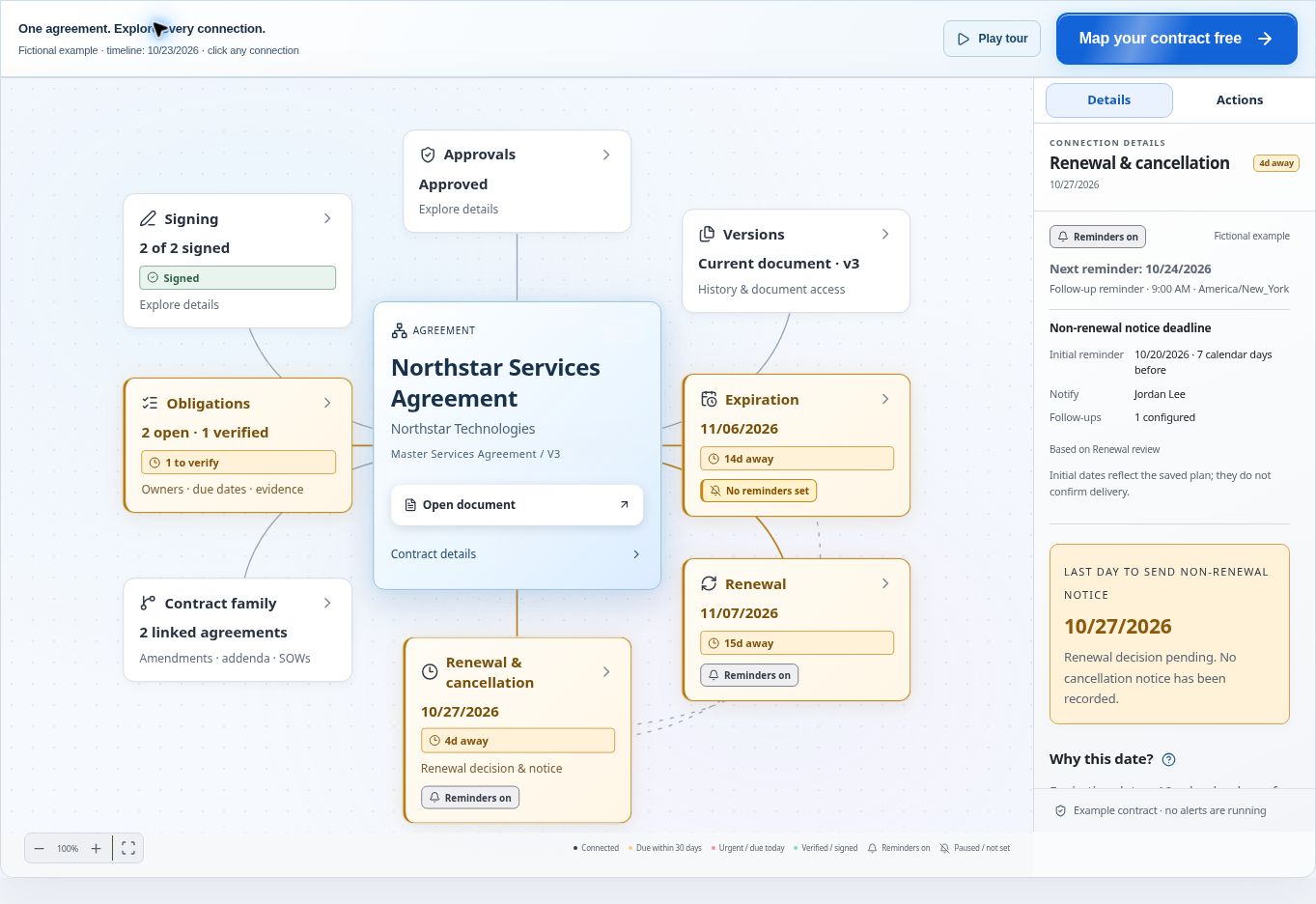
Now inspect the separate shared Northstar map example. This saved demonstration shows a later fictional state with Signing at 2 of 2 signed and Versions at Current document · v3. Use it to learn where to inspect the saved renewal information. Its screen state does not establish that the unsigned file used earlier was actually routed or signed.
- Select Renewal & cancellation on the map. In Details, read Non-renewal notice deadline.
- Check Initial reminder at 10/20/2026 and Notify at Jordan Lee. The visible follow-up is scheduled for 10/24/2026.
- Compare Expiration at 11/06/2026 and Renewal at 11/07/2026 with the earlier 10/27/2026 event. The demonstration identifies its timeline as 10/23/2026.
Why this matters. The map’s callout refers to the last day to send a notice. The training clause requires receipt. A display label can help you find the date. The actual wording determines what evidence the team must obtain.
Record the notice cutoff separately from term end
In your organization’s training agreement, use a distinct event for the notice cutoff and a distinct event for expiration. Include the renewal start when it applies. Add a source reference to the governing clause, and note how the cutoff was derived or expressly stated. Ask another person to reconstruct the three dates from that source.
Keep a separate internal target for issuing an approved notice. Calling an internal target “contractual deadline” can create false confidence or make a manager think a right has already expired. If the relationship between two values changes through an amendment, record the amended basis before adopting revised reminders.
Configure reminders early enough for the internal decision
Choose the person who must act and the person accountable for follow-up. For Northstar, Casey Brooks is the business owner in the original training document. Jordan Lee is the customer’s service contact and the named recipient in the separate map example. Ask who will carry the business decision from Jordan’s attention to Casey’s recommendation.
In the shared fixture, the initial reminder falls seven calendar days before the notice cutoff. The follow-up falls on Saturday, October 24, at 9:00 AM in America/New_York. Decide whether your team works that Saturday. If it does not, establish an earlier staffed checkpoint and backup coverage as part of the practice plan.
Use dates in a separately labeled future training record when testing actual reminder delivery with approved internal recipients. The historical Northstar image is a reference. Its footer identifies an example with no alerts running. Contract renewal tracking
Run the renewal review
Use renewal views to identify upcoming decisions
Review the portfolio by next decision and owner. Include records with a missing cutoff in a separate exception list. Give each coming deadline a source reference, business recommendation status and next action. A calendar view makes several deadlines landing on the same week easy to spot. Contract calendar
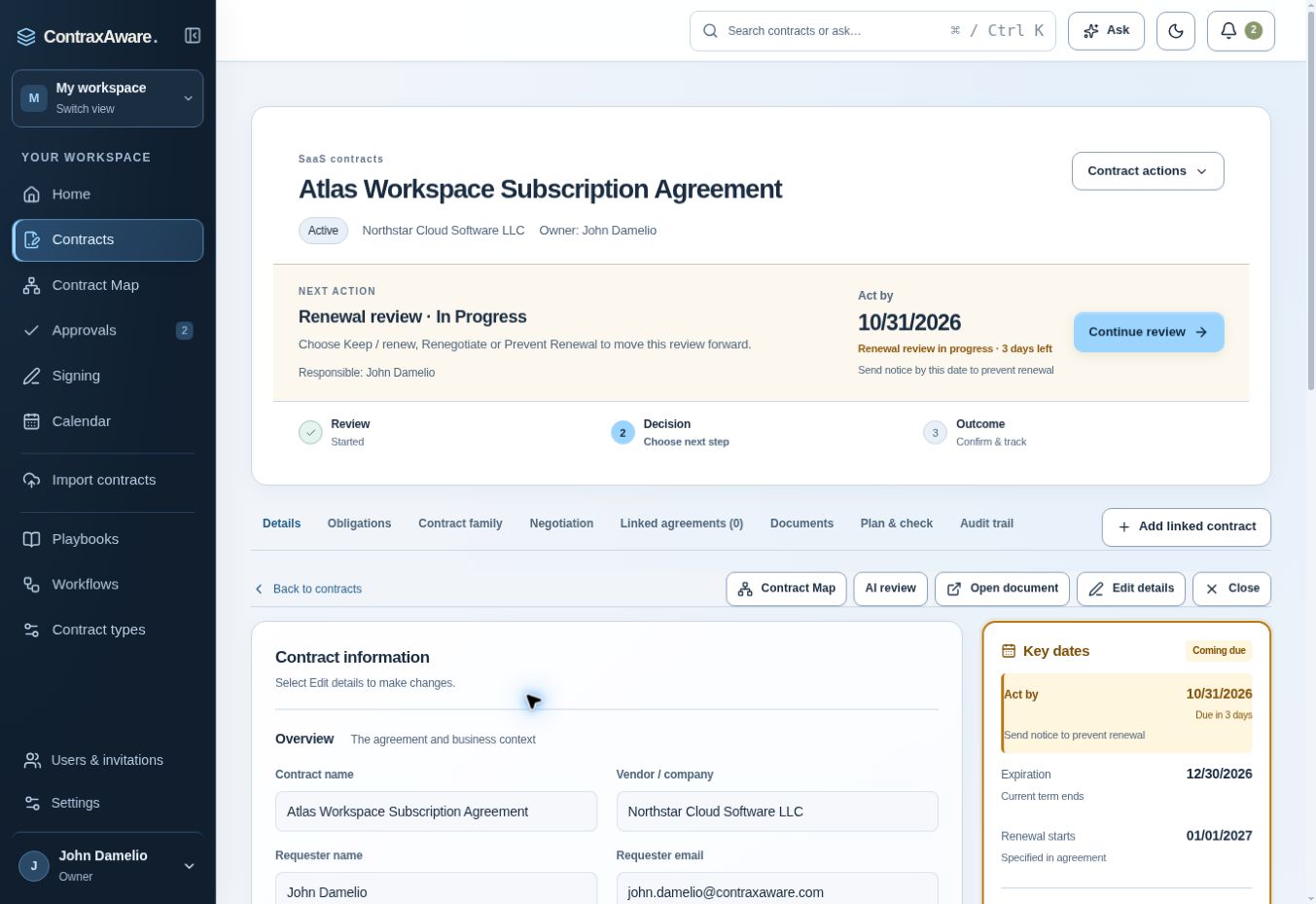
For a second, independent example, inspect the Atlas Workspace Subscription Agreement capture. Under Key dates, read Act by at 10/31/2026, Expiration at 12/30/2026 and Renewal starts at 01/01/2027. The displayed Renewal review · In Progress offers Continue review. Use that control to resume an authorized training review. The captured screen ends at that choice.
December 31 falls between the displayed expiration and renewal start. Before scheduling work around that gap, check the governing clause and any amendment with the contract owner.
Atlas is an active subscription sample. Its supplier is Northstar Cloud Software LLC. The Northstar Services Agreement used earlier has different parties, dates and wording. In a real portfolio, reading only the word “Northstar” would be an easy way to prepare the wrong notice.
Assign the business owner and collect performance evidence
Give Casey a decision memo for the Northstar exercise. Include source terms, ongoing business need, cost of the next term, outstanding performance issues and options for continuity. The source quotes USD 2,000 monthly, or USD 24,000 annually. Identify usage changes or additional work separately.
The quarterly service report is due October 30, three days after the proposed notice receipt cutoff. Ask for an interim performance summary before October 27. Record what evidence remains outstanding, who can estimate the effect, and who can decide with that uncertainty. A quarterly reporting cadence should not automatically determine the timing of the buyer’s decision.
Record the chosen action and necessary approvals
Write the proposed decision in precise business terms. “Seek revised response-time commitments and permit renewal only after the budget owner approves the revised fee” creates a task and a boundary. “Talk to supplier” lacks either. If the owner chooses continued negotiation, record the fallback decision and the latest time it can be authorized.
Attach or reference the corresponding approval evidence in the training record. If the business approves an extension that still requires signatures, retain the pending documentation and follow-up owner. The approval establishes internal authority. The agreement’s terms and the evidence of execution determine when the extension can govern the working register.
Close the loop
Attach notice and delivery evidence
Use a fictional acknowledgment for the exercise and mark it as practice evidence. Save it with the sample notice, approved recipient and corresponding record. Record the date and time of receipt, the source of that information and any uncertainty. Ask a second reviewer to state what requirement the evidence satisfies.
If no acknowledgment is available, record dispatch and delivery facts separately and assign follow-up. Avoid treating an internal test notification as notice to the counterparty. Actual external contractual communication belongs with the person authorized by the organization and must follow the governing clause.
Update the agreement after the verified outcome
In a fictional outcome where valid notice prevents renewal, retain the current service end of November 6 and schedule the transition work. Review final billing, access, outstanding quarterly reports and any obligations with later dates. Identify what remains open even after the renewal decision is complete.
If instead the parties agree to a revised term, locate the controlling text and its effective conditions. Verify the replacement dates against the document. Record who checked them, preserve the earlier dates and test the next renewal decision from the new basis.
Test overdue escalation and the backup-owner process
Run a tabletop exercise in which Casey is unavailable and a reminder remains unanswered. Give the backup only the information they could reach using their regular permissions. Time how long it takes to identify the decision, governing deadline, authorized delegate and evidence needed.
Ask the backup to explain what can be done immediately and what requires approval. End the test when a named person accepts the next assignment and demonstrates access to the source. Record any missing permission or contact as a concrete correction. Repeat the test using the same scenario after the correction.
Practice building a backward schedule
Treat October 27 as a hard receipt deadline for the historical exercise. Use September 28 to gather usage, open service issues and an interim supplier report. By October 9, ask Casey to compare renewal, revised terms and transition. By October 16, identify the preferred decision, approval owner and fallback.
Use October 20 for authority and delivery preparation. Choose an internal dispatch target that leaves time to obtain acknowledgment before October 27. Check that the recipient, channel and delivery evidence match the practice clause. Record who will take over if Casey is unavailable on October 16. The intermediate dates are your team’s planning choices.
For the advanced challenge, a fictional amendment extends the current term but says nothing new about notice. Compare the original’s explicit October 27 date with its period expressed relative to expiration. Identify the exact conflict or ambiguity for authorized legal review. Preserve both source values and place an early internal follow-up on the calendar until the interpretation is resolved. A confident new cutoff without that analysis fails the exercise.
John's Builder Note
When I look at a reminder, I want to know who can do what next. “Contract expires soon” sends someone searching for the problem. “Casey needs a budget decision by Friday so Jordan can obtain written acknowledgment before October 27” gives two people work they can actually complete.
Questions from the field
Can the team use a standard ninety-day renewal reminder?
Use it as an initial practice for a defined portfolio. Check each contractual deadline and the work needed before relying on it. A long notice window or lengthy procurement process can require an earlier first review.
What if the supplier verbally agrees to give us extra time?
Record the conversation and ask the authorized reviewer which written evidence or agreement is needed to change the operative deadline. Continue to monitor the existing deadline until the organization can substantiate a different one.
Optional knowledge check
Choose your answer, then open the explanation.
Show answer
Not necessarily; verify delivery and receipt requirements. Sending and receiving are different events. Use the clause and authorized guidance to establish compliant timing.
Show answer
Early enough to allow review, negotiation and valid notice. The team needs time to choose and carry out the action before the contractual deadline.
Show answer
Only that a reminder was delivered. Reminder delivery is not evidence of a decision or valid contractual notice.